

Stop sending information. Start creating understanding.
A lot of change communication is unreadable.
Not because employees don’t care — but because communicators forget the point. They chase completion, not comprehension. They write to update, not to align.
The result: walls of text, vague subject lines, and audiences drowning in corporate noise.
In a world where attention is currency, clarity is what earns trust. And if you can’t write a message people actually read, your transformation will stall — no matter how many town halls you schedule or decks you produce.
Why change messages fail — and what nobody admits
When leaders say “we need more communication,” what they usually mean is “we’re losing control.” So they send more. More updates, more FAQs, more progress reports, more cascades.
But noise doesn’t drive adoption. Meaning does.
Here’s what actually kills most change messages — and why each one is a structural problem, not a writing problem:
No emotional context. Messages lead with tasks and timelines without ever answering the question every employee is actually asking: why does this matter to me? Until that question is answered, nothing else lands.
No clear structure. The key point is buried halfway down after three paragraphs of background that only the sender thinks is necessary. By the time the reader gets to what matters, they’ve already stopped reading.
Too much jargon. If employees need a decoder ring to understand what’s changing, you’ve lost them before the second paragraph. Corporate language creates distance when the goal is connection.
No story. People can’t see themselves in the change because the message describes the organization’s journey, not theirs. A change message that doesn’t answer “where do I fit in this?” isn’t a change message — it’s an announcement.
No rhythm. Communication happens when someone remembers to send something, not according to a predictable cadence. Random updates create anxiety. Predictable ones build trust.
These aren’t writing failures. They’re design failures. And they’re all fixable — but only once you understand what a change message is actually supposed to do. (For the structural view, read What Is Change Communications?)
The fix — write with clarity, not corporate
Your job isn’t to send messages. It’s to translate transformation into words that move people to act.
To do that, you need to write from inside the change — not above it. You need to write for the person reading, not for the person approving. And you need a structure that does the cognitive work for the reader rather than leaving them to figure out what matters on their own.
Here’s how to do it, step by step.
Seven steps to a change message people actually read
Step 1 — Define the “why” before the “what”
Before you type a single word, ask: why does this change matter to them — not just to leadership?
Most communicators skip straight to logistics: dates, timelines, deliverables. But until people understand why the change exists, the what won’t land. The brain doesn’t process new information in a vacuum — it processes it in the context of meaning. Give people the meaning first and the details become navigable. Skip the meaning and the details become noise.
Make it human. Start with the problem the change solves. Acknowledge the disruption honestly. Tie every detail to the purpose, not the process.
What this looks like:
❌ “Starting July 15, the new asset management platform goes live.”
✅ “Starting July 15, our teams will have one connected view of every asset — so we can make faster, safer decisions on the ground.”
That one sentence moves the message from information to meaning. That’s the shift every change message needs to make.
Step 2 — Build your message on the Change Message Pyramid
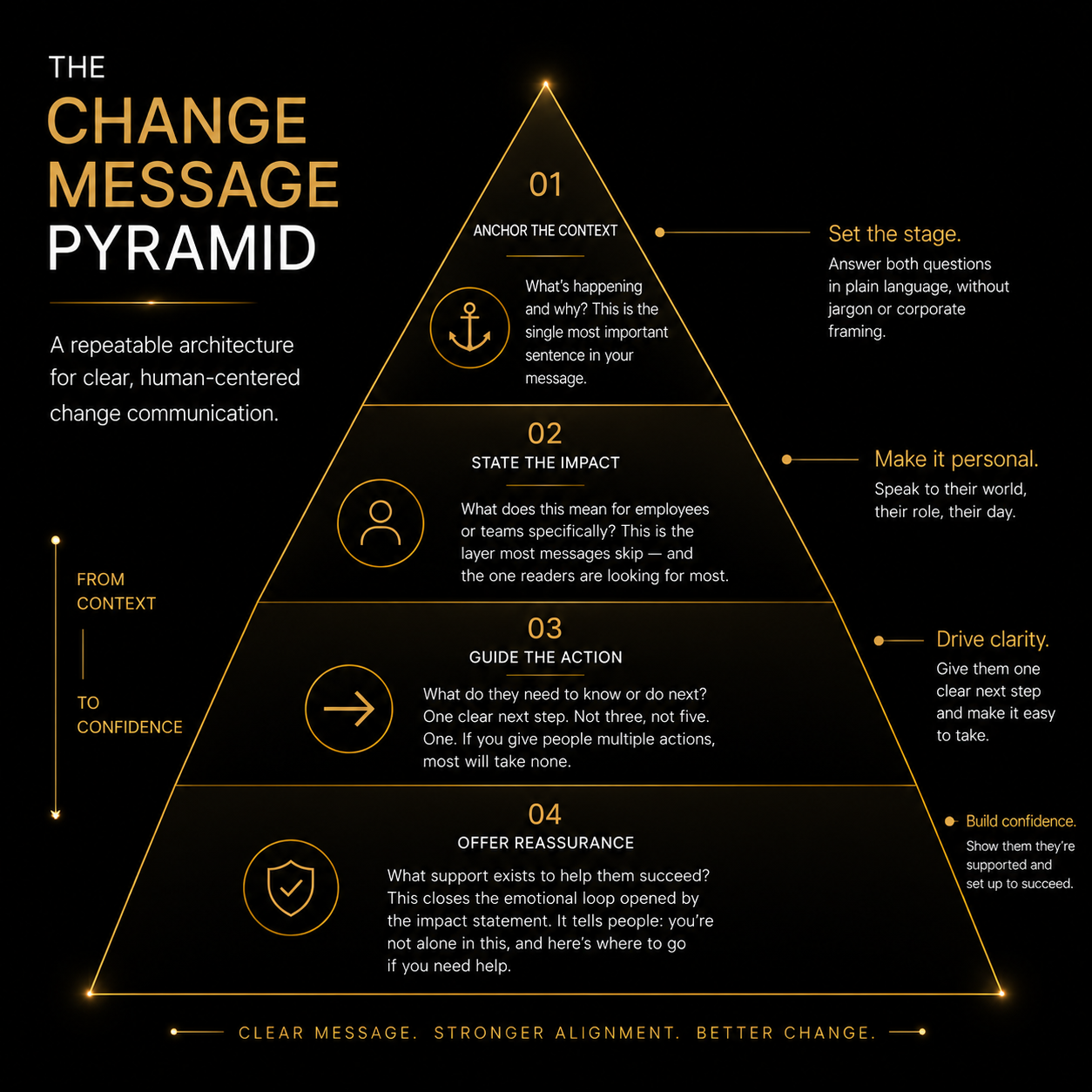
Every effective change message follows a predictable flow. I developed the Change Message Pyramid to give communicators a repeatable architecture that keeps messages tight, readable, and emotionally grounded — regardless of the complexity of the change.
The four levels:
Anchor the context — what’s happening and why? This is the single most important sentence in your message. It should answer both questions in plain language, without jargon or corporate framing.
State the impact — what does this mean for employees or teams specifically? Not for the organization, not for the project — for the person reading. This is the layer most messages skip, and it’s the one readers are looking for most.
Guide the action — what do they need to know or do next? One clear next step. Not three, not five. One. If you give people multiple actions, most will take none.
Offer reassurance — what support exists to help them succeed? This closes the emotional loop opened by the impact statement. It tells people: you’re not alone in this, and here’s where to go if you need help.
When you write without this structure, your audience spends cognitive energy figuring out what matters. When you write with it, they spend that energy taking action. The structure does the work so the reader doesn’t have to.
Step 3 — Use storytelling to create understanding
Facts tell. Stories transform.
Humans don’t retain bullet points — they remember narratives. If you want someone to care about a change, stop dumping data and start building a story arc. Every change message has a natural three-beat story inside it:
Here’s where we are → Here’s what’s changing → Here’s how you fit in.
That sequence gives readers cognitive safety — a way to locate themselves in the change rather than feeling like something is happening to them. When people can see where they fit, they stop bracing and start engaging. (For the full psychology behind this, read The Psychology of Alignment.)
Mini example: “We’ve been managing projects across multiple systems. Starting this fall, we’ll unify them into one platform. That means fewer logins and faster visibility into work orders — for everyone on the team.”
Simple. Visual. Repeatable. That’s clarity in motion.
Step 4 — Make language do the heavy lifting
Corporate writers love to “optimize,” “streamline,” and “implement.” But nobody talks like that — and if your message does, it dies on arrival. Corporate language signals that the message was written for the organization, not for the reader. And readers know it immediately.
Swap corporate words for human ones:
| Corporate Word | Clarity Alternative |
|---|---|
| Implement | Start / launch / introduce |
| Optimize | Improve / make easier |
| Stakeholders | Teams / people / partners |
| Rollout | Launch / transition |
| Initiative | Change / effort / project |
When in doubt, read your message out loud. If it sounds robotic, rewrite it until it doesn’t. If you’d never say it in a conversation, don’t put it in a message.
Step 5 — Design for how humans actually read
Even the clearest message fails if it’s formatted like a wall of text. Your audience is skimming between meetings, assignments, and overflowing inboxes. Respecting their attention is part of communicating clearly.
Use short sentences — under 20 words where possible. Break up text with subheads so readers can navigate rather than wade. Bold one key takeaway per section — not five, not ten, one. Keep paragraphs under four lines, because mobile readers are reading in portrait mode with limited screen space and limited patience.
Clarity isn’t just what you say. It’s how you make it feel easy to read. The same content in a wall of text and in a well-structured message will produce completely different levels of comprehension — not because the words changed, but because the cognitive load changed.
Step 6 — Build rhythm, not randomness
Change communication shouldn’t feel like an ambush. Predictability is trust.
Set a consistent cadence — weekly, bi-weekly, whatever suits the scale and pace of your program — and protect it. When employees can anticipate updates, they stop bracing for surprises and start trusting the process. The silence between communications stops feeling like a sign that something has gone wrong.
The best communicators aren’t the loudest. They’re the steadiest. And steadiness is something you design into a communication program — it doesn’t happen on its own. (For how to build that rhythm into a full strategy, read How to Build a Change Communications Strategy.)
Step 7 — Measure understanding, not output
Most communicators measure success by activity: emails sent, articles published, town halls hosted. But activity doesn’t equal adoption. It doesn’t even equal comprehension.
Measure understanding instead. Do people know what’s changing? Do they understand why? Can they explain it in their own words to someone who wasn’t in the room? Can they make a decision based on what you communicated without having to ask a follow-up question?
If the answer to any of those is no, the message didn’t land — regardless of how many people opened the email. The goal isn’t more communication. It’s clearer communication that actually changes what people know and do. (For how to measure this properly, read The Clarity Gap.)
What this looks like in practice
I worked with a communications team that was sending three to four updates a week during a major system implementation. Open rates were declining. Questions hadn’t stopped. Leaders were frustrated.
When we diagnosed the problem, the messages were frequent and well-formatted — but they led with process, not purpose. Every update described what was happening with the system. None of them answered what it meant for the people using it.
We rebuilt the message architecture around the Change Message Pyramid. Purpose first, impact second, action third, reassurance fourth. We cut the frequency in half and doubled the meaning per message.
Within four weeks, the follow-up questions dropped significantly. Not because we communicated more — because we communicated better.
The new rule of change writing
Clarity is the new currency of influence.
When your message is clear, leaders look confident, employees feel informed, and projects move faster. When it’s not, confusion costs more than silence ever will.
So before you send your next update, stop and ask: does this create clarity or just activity?
If it’s the latter, you’re not communicating. You’re adding noise.
FAQs: Writing change messages
Every effective change message needs four things: context that anchors the reader in what’s happening and why, a clear statement of impact that explains what this means for them specifically, one concrete next step or action, and a reassurance element that tells people where to go for support. That’s the Change Message Pyramid — and it works for emails, town halls, manager briefings, and any other change communication format.
Because they’re written for the sender, not the reader. They lead with logistics instead of purpose, use corporate language that creates distance, and bury the key point halfway down after paragraphs of context that only the writer thinks is necessary. The fix is structural — define the why before the what, lead with meaning, and use the Change Message Pyramid to keep the message tight and reader-focused.
A message architecture developed by Ana Magana that structures change communication around four layers: anchor the context (what’s happening and why), state the impact (what this means for the reader), guide the action (one clear next step), and offer reassurance (what support is available). It gives communicators a repeatable structure that does the cognitive work for the reader.
Ask three people who weren’t involved in writing it to explain it back to you in their own words. If their versions match the intent, the message is clear. If they diverge, identify which layer of the pyramid broke down — was the context unclear, the impact unstated, the action ambiguous, or the reassurance missing?
The Clarity Framework™ sits above individual message writing — it’s the strategic methodology that defines the narrative, rhythm, and measurement system that change messages then express. When the framework is in place, writing individual messages becomes significantly easier because the core story, the audience, and the purpose are already defined. The message becomes an expression of clarity rather than an attempt to create it.
Leading with what instead of why. When a message starts with the change itself — the new system, the new process, the new structure — without first establishing why it matters, readers have no frame for interpreting what follows. They process the information without meaning, which means they process it without retaining it. Start with the problem the change solves and the message lands completely differently.
Make it repeatable in conversation, not just readable on a screen. The three-beat story structure — here’s where we are, here’s what’s changing, here’s how you fit in — works equally well as a talking point and as a written message. If a manager can tell the story in two minutes without slides, the message has been written clearly enough to cascade.

Want change messages that actually move people?
I’m Ana Magana, a change communications and change management consultant based in Calgary, Alberta. I help organizations write change messages that land — through The Clarity Framework™ and the Change Message Pyramid.
Work with me →
Read: The Psychology of Alignment: How Humans Process Change | How to Build a Change Communications Strategy | The Clarity Gap: Why Leaders Think They’re Being Clear