

Because clarity isn’t corporate — it’s human.
Why clarity matters in change communication
Clarity is the most overlooked leadership skill in transformation.
Change doesn’t fail because people resist it. It fails because they don’t understand it.
Most organizations mistake communication volume for impact. Emails. Town halls. SharePoint updates. Meeting cascades.
And yet — confusion grows.
The truth is, information isn’t the problem. Noise is. Without structure, rhythm, and empathy, communication becomes static — loud but unintelligible.
That’s where The Clarity Framework™ comes in.
It’s a change communication framework I developed after years of working with leaders navigating complex transformation. A repeatable method built on five principles to make complex change make sense.
What is The Clarity Framework?
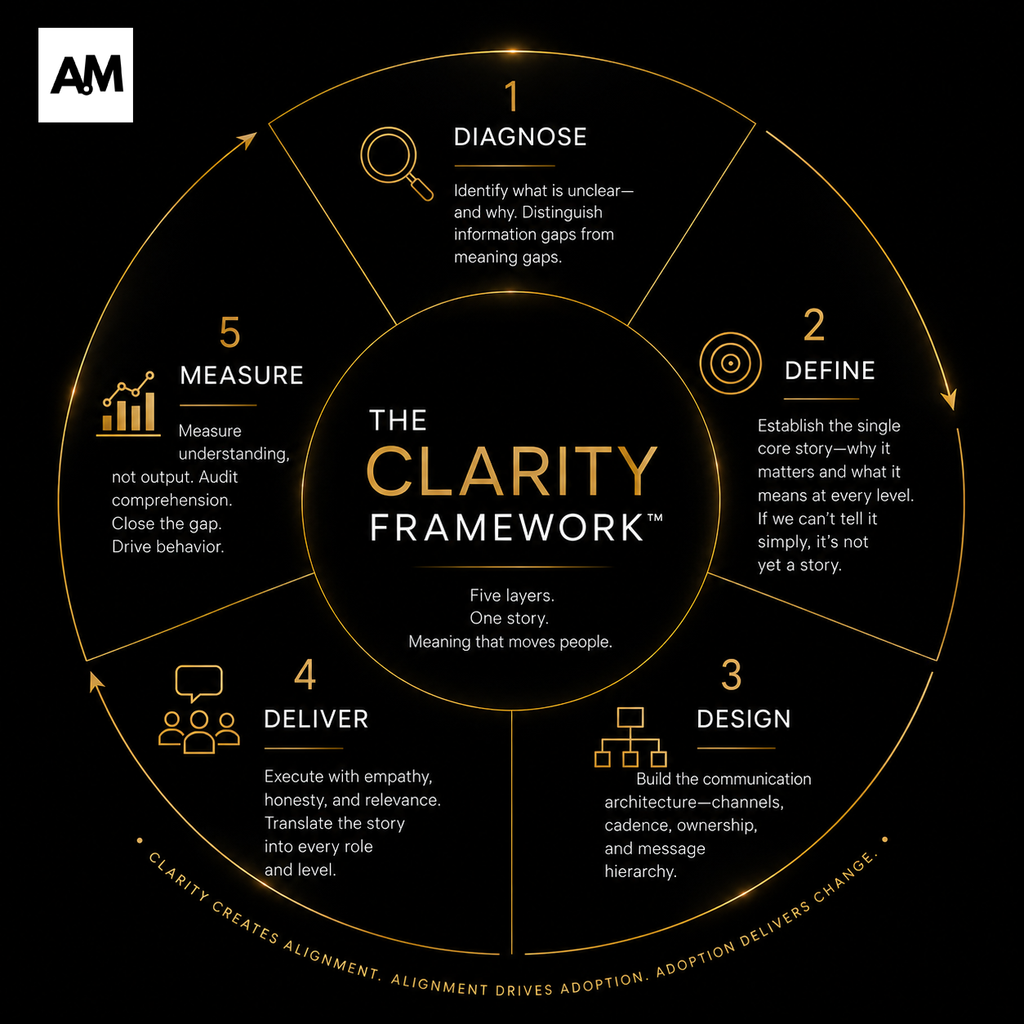
The Clarity Framework is a structured approach to change communication that combines storytelling, rhythm, and empathy to help organizations cut through complexity and connect with their people during transformation.
It’s not a generic change management model. It’s not a rollout checklist.
It’s a method for creating meaning — so people don’t just receive information about change, they believe in it.
The framework is built on five principles. Each one is repeatable, regardless of how complex the change. And each one addresses a specific failure point in how most organizations communicate transformation — the places where communication breaks down not because people aren’t trying, but because the architecture underneath it was never designed to produce understanding at scale.
Noise is the real enemy
When everyone’s “communicating,” no one’s connecting.
In the absence of clarity, people fill the gaps with assumption and anxiety. Leaders contradict each other. Teams hesitate. Projects stall.
Noise isn’t harmless. It drains trust, time, and energy. Because when people can’t find the signal, they stop listening.
In change, noise doesn’t create alignment — it creates avoidance.
This is what I call signal fatigue — the exhaustion that comes not from too much change but from too many messages arriving without enough meaning. It’s distinct from change fatigue, which is about the pace of change. Signal fatigue can occur in a well-paced transformation if communication is high-volume and fragmented. The signs are recognizable: employees ignore official channels, managers won’t cascade, informal networks replace formal communication as the primary source of real information.
Volume doesn’t cure signal fatigue. Clarity does.
Clarity is a leadership act
Clarity isn’t a comms tactic. It’s a leadership behavior.
The best leaders translate complexity into meaning, create consistency that builds trust, and communicate with empathy instead of ego.
Those three traits — translation, rhythm, and empathy — are what separate calm communicators from chaotic ones.
The calm communicator isn’t a personality type. It’s a disciplined approach — the leader who slows down when everyone else speeds up, who resists the pull toward more volume, and who focuses on producing understanding rather than activity. When calm becomes part of how a leader communicates, it replicates through the organization. Managers who receive grounded, honest communication deliver grounded, honest communication to their teams. Calm multiplies down. So does chaos.
When clarity becomes part of how you lead, transformation stops feeling like chaos and starts feeling like progress.
The hidden cost of poor change communication
According to Prosci’s global research, projects with excellent change management are seven times more likely to meet or exceed objectives.
And the number-one success factor?
“Communicate frequently and openly.” — Prosci Benchmarking Report
But frequency alone doesn’t drive results. Precision does.
When communication is clear, targeted, and consistent, 79% of change initiatives succeed. When it’s inconsistent or vague, success drops to 27%.
That’s not a small gap. That’s the cost of confusion.
Translation: clarity drives ROI.
The Clarity Framework — 5 principles for change communication that lands
The Clarity Framework helps organizations cut through complexity, align leadership, and connect with their people during transformation.
Here are the five principles that make clarity repeatable — no matter how complex the change.
Principle 1: Diagnose what’s blocking understanding
Most change teams skip straight to output — town halls, toolkits, talking points — without diagnosing what’s actually unclear.
Clarity starts with curiosity. Ask:
- Where are people getting stuck — the process or the purpose?
- Do leaders share the same message?
- Is the story understood the same way at every level?
This is the step most organizations skip. They assume confusion is about information gaps. Often, it’s about meaning gaps — competing stories at different levels of the organization that quietly contradict each other.
What I call narrative drift — where different leaders describe the same change using slightly different language and emphasis — is almost always the real source of confusion. Employees don’t average out the divergent versions. They distrust all of them. A single degree of drift at the leadership level produces significant fragmentation by the time the message reaches frontline teams through multiple layers of translation.
Diagnosing before delivering means distinguishing between information gaps — where people lack facts — and meaning gaps — where people have facts but can’t make sense of them. The interventions for each are completely different. Treating a meaning gap as an information gap produces more content on top of unresolved confusion.
When you diagnose before you deliver, you stop reacting and start leading. (For a deeper look at the most common diagnostic failures, read The 7 Change Management Mistakes That Derail Initiatives.)
Principle 2: Define one core story
Every change needs a single throughline — the story that explains why it matters.
Your story should answer three questions:
Where are we now → What’s changing → Why it matters to me.
If people can’t repeat that in their own words, you don’t have clarity yet.
This is harder than it sounds. Most organizations can explain what is changing in detail. Far fewer can explain why in a way that resonates simultaneously with a frontline employee, a middle manager, and a senior leader.
The core story has to work at every level. That’s the test.
And there’s a second test: consistency. The clarity gap — the distance between what leaders believe they’ve communicated and what people actually understand — almost always originates here. Leaders have months of context that employees never receive. What feels concise and obvious to someone who built the strategy feels incomplete or cryptic to someone encountering it for the first time.
Defining one core story means closing that gap before the first message goes out. It means running the story through the Anchor Framework™ — define the purpose, anchor on truth, decide on direction — so that every leader is working from the same narrative spine before they communicate externally. (For more on the clarity gap and how it develops, read The Clarity Gap.)
Principle 3: Design a communication rhythm
Communication rhythm isn’t about frequency. It’s about predictability.
A steady cadence — weekly updates, consistent channels, clear ownership — builds trust because people know when to expect information. Random or reactive updates do the opposite: they signal instability and amplify anxiety.
Predictability is a trust mechanism. When people know when clarity is coming, they stop filling the silence with the worst plausible interpretation of events. The Cadence Map for any change program should define when updates happen, what they cover, who owns them, and how they’re reinforced at the manager level — not just when a milestone arrives, but as a sustained rhythm through the full program.
Define your cadence early. Assign who communicates what, through which channels, and on what schedule. Then stick to it — especially when things are uncertain. Uncertainty is exactly when leaders go quiet. It’s also exactly when people need to hear from them most.
Predictable communication helps people feel anchored, even when everything else is shifting. (For how to design that rhythm into a full strategy, read How to Build a Change Communications Strategy That Actually Works.)
Principle 4: Deliver with empathy, not ego
Empathy is the difference between being heard and being believed.
That means dropping the corporate tone. Speaking honestly about what you don’t know yet. Acknowledging that change is hard, even when it’s necessary. Inviting questions instead of broadcasting answers.
But deliver is also about sequence. Humans don’t process change rationally first — they process it emotionally, then cognitively, then through the lens of identity, and finally into behavior. Communication that leads with operational detail before addressing the emotional and identity layers produces the resistance that gets misdiagnosed as people being difficult. It’s almost never that. It’s almost always that the emotional layer wasn’t addressed before the cognitive one was loaded.
Emotional asymmetry is the gap between a leader’s emotional state when delivering a message and the audience’s emotional state when receiving it. Leaders have usually processed the news already. Employees are hearing it for the first time. Communicating from a place of resolution before the audience has had any time to absorb the news makes even technically clear messages land as dismissive.
Empathy doesn’t soften the message — it makes people trust it. And in transformation, trust is the currency that determines whether people follow or freeze. (For the full treatment of emotional processing during change, read The Psychology of Alignment.)
Principle 5: Measure understanding, not just output
Open rates, attendance numbers, and content volume are activity metrics. They tell you what you sent, not whether anyone understood.
Real measurement asks: Can employees explain what’s changing in their own words?
Audit messages across leaders and channels for consistency. Listen more than you publish. When everyone’s version of the story sounds the same — without being scripted — that’s when you know clarity has landed.
The behavioral signals of real understanding are specific and observable. Managers cascade messages confidently without calling back for clarification. Questions from employees become more specific and operational over time rather than broad and anxious. Decision-making happens at the right level without constant escalation. The informal network is running a story that’s consistent with the official one.
These signals tell you whether the communication architecture is working — not whether content was produced, but whether understanding was built.
Clarity is proven when everyone’s story sounds the same without scripts needed. (For how to build a measurement system that captures these signals, read The 6 Signs of a Healthy Communications Culture.)
The named concepts within The Clarity Framework
Over years of applying The Clarity Framework inside complex organizations, I’ve developed specific diagnostic language for the patterns it addresses. These named concepts appear throughout the body of work on this site — each one a precise description of something that happens when clarity breaks down.
The Clarity Gap — the distance between what leaders believe they’ve communicated and what people actually understand and can act on. Present in almost every transformation program. Almost never diagnosed correctly. (Read more: The Clarity Gap)
Narrative drift — what happens when different leaders describe the same change using different language or emphasis, even subtly. Employees don’t average out the divergent versions — they distrust all of them. A single degree of drift at the leadership level produces significant fragmentation by the time the message reaches frontline teams.
Signal fatigue — the exhaustion that comes from too many messages with too little meaning. Distinct from change fatigue, which is about the pace of change. Signal fatigue can occur in a well-paced transformation if communication is high-volume and fragmented.
Emotional asymmetry — the gap between a leader’s emotional state when delivering difficult news and the audience’s emotional state when receiving it. Leaders have processed it. Employees are encountering it for the first time. Communicating from resolution before the audience has absorbed the news makes even accurate messages land as dismissive.
The calm communicator — not a personality type but a disciplined approach to leadership communication during change. Characterized by composure over control, simplicity over sophistication, rhythm over reactivity, and empathy over optics.
The calm cascade — the principle that leadership emotional tone replicates as it moves through the organizational hierarchy. Every leader communication is an emotional vector carrying not just information but psychological tone that employees mirror. Calm multiplies down. So does chaos.
Clarity is containment — the principle that clarity during uncertainty isn’t about having all the answers. It’s about naming what’s known, acknowledging what isn’t, and giving people enough structure to function while the picture continues to develop.
How The Clarity Framework relates to ADKAR
For practitioners who work with Prosci’s ADKAR model — the most widely used individual change management framework in the world — The Clarity Framework is its organizational complement, not its replacement.
ADKAR operates at the individual level. It describes the five stages each person moves through during change: Awareness, Desire, Knowledge, Ability, Reinforcement. It’s a diagnostic tool for where individuals are in their change journey.
The Clarity Framework operates at the organizational level. It describes how organizations design the communication architecture — the narrative, the rhythm, the leadership alignment, the measurement — that enables those individual ADKAR stages to occur at scale.
ADKAR tells you what needs to happen inside each person. The Clarity Framework tells you how to design the organizational conditions that make it happen across hundreds or thousands of people simultaneously.
Used together, they address the complete change management challenge — individual stage diagnostics driving organizational architecture design, organizational architecture creating the conditions for individual stage progression. (For the full treatment of how they work together, read How The Clarity Framework™ Complements ADKAR.)
What this looks like in practice
When I worked with a leadership team navigating competing transformation messages, the first step wasn’t a new communication campaign. It was defining a single shared narrative: one story that every leader could tell in their own words.
From there, we rebuilt their communication rhythm around that narrative.
The results were tangible: a visible drop in confusion across teams, faster decision-making at the leadership level, and an aligned story that held across channels and time zones.
Clarity didn’t just make communication better. It made execution possible.
Final thought
Clarity isn’t just how you communicate. It’s how you lead.
When you make information make sense, you help people believe in what they’re building — together.
Because clarity doesn’t slow change down. It makes it sustainable.
Frequently asked questions about The Clarity Framework
A change communication framework is a structured method for planning, delivering, and measuring how information about organizational change is shared — across leaders, teams, and channels. An effective framework defines the story, the rhythm, and the proof that understanding has actually landed.
The Clarity Framework is a change communication methodology developed by Ana Magana. It’s built on five principles — Diagnose, Define, Design, Deliver, and Measure — to help organizations translate complex change into clear, human communication. Unlike traditional change management models, it focuses on meaning over compliance and understanding over output.
Because people don’t resist change — they resist confusion. Most communication efforts focus on volume: more emails, more meetings, more content. What’s missing is a clear, consistent narrative that people can actually understand and repeat. Clarity fixes that.
Diagnose what’s blocking understanding. Define the core story. Design a rhythm that feels human. Deliver with empathy, not ego. Measure understanding — not just output.
Narrative drift is what happens when different leaders describe the same change using different language or emphasis, even subtly. Employees don’t average out the divergent versions — they distrust all of them. A single degree of drift at the leadership level produces significant fragmentation by the time the message reaches frontline teams through multiple layers of translation.
Signal fatigue is the exhaustion that comes from too many messages with too little meaning. It’s distinct from change fatigue — which is about the pace of change — and it can occur in a well-paced transformation if communication is high-volume and fragmented. The signs: employees ignore official channels, managers won’t cascade, and informal networks replace formal communication as the primary source of real information.
ADKAR is an individual change management model — it describes the five stages each person moves through during change. The Clarity Framework is an organizational communication architecture model — it describes how organizations design the conditions that enable those individual stages at scale. They’re complementary rather than competing. ADKAR diagnoses where individuals are. The Clarity Framework designs the organizational conditions that move them forward.
Most change management models focus on process and adoption metrics. The Clarity Framework focuses on meaning — helping people believe in what they’re building, not just comply with it. It addresses the organizational communication architecture that most models leave undefined.
When a clear narrative and consistent rhythm are in place, leaders typically notice a shift in alignment and decision-making within four to eight weeks. The diagnostic phase alone often surfaces misalignments that have been quietly stalling progress for months.
Yes — the principles are designed to be led internally. That said, an outside perspective during the diagnostic phase often surfaces blind spots that are invisible from inside the organization.
Ana Magana is a strategic change management and communications consultant based in Calgary, Alberta. She helps organizations navigate transformation with structure, empathy, and storytelling — through The Clarity Framework™.
If your organization is navigating change and you’re not sure why communication isn’t landing, that’s often where the work begins. Work with Ana →
Related reading: The Clarity Gap: Why Leaders Think They’re Being Clear → The Psychology of Alignment: How Humans Process Change → How The Clarity Framework™ Complements ADKAR →