


Most communication plans are built to inform. The ones that actually work are built to align.
The problem with “plans” that don’t communicate
Every organization has a communication plan for change: timelines, talking points, and slide decks that look perfect in theory.
But when rollout begins, silence sets in.
Emails go unread. Leaders improvise. Employees tune out.
The plan exists — but communication doesn’t.
That’s because most plans are logistics, not strategy. They describe what to send and when, but never why people should care.
And when meaning is missing, even the best plan collapses under the weight of confusion.
Real change communication isn’t about updates. It’s about understanding.
Why change communication strategies fail
Change fatigue isn’t about too much change — it’s about too much unclear change.
When people don’t understand the purpose behind transformation, they fill the gaps with worry and assumption. The result: delays, disengagement, and quiet resistance that looks like apathy but isn’t.
Most organizations diagnose this as a people problem. It’s almost always a communication problem.
That’s why clarity is the foundation of any effective change communication strategy. Before you send a single message, you need to be able to answer three questions:
- Why this change, and why now?
- What does it mean for me specifically?
- What happens next, and when?
If your team can’t answer those three questions consistently — across every leader, every level, every channel — your strategy is structured noise.
The 5 elements of a change communication strategy that works
1. Define the narrative before the channels
Don’t start with tools — start with story.
Every change needs a single clear throughline:
Where we are → What’s changing → Why it matters → What you can do
That narrative becomes the anchor for every town hall, email, and conversation that follows. Without it, every message becomes a new interpretation of reality — and inconsistency is where trust goes to die.
This is the step most organizations skip entirely. They move straight to channel planning and content calendars without ever agreeing on the story. Then they wonder why messages land differently at different levels of the organization.
Define the narrative first. Everything else flows from it.
(For a deeper look at building message structure that scales, read The Clarity Framework™.)
2. Create a predictable rhythm
Communication isn’t about frequency. It’s about predictability.
Random updates increase anxiety. Predictable updates build safety.
When people know when to expect information — weekly leadership updates, bi-weekly all-hands, monthly written summaries — they stop filling silence with rumor. Predictability signals that someone is in control, even when the situation is uncertain.
Set a cadence and protect it. The moment your rhythm breaks down, trust starts eroding. And once employees learn that silence means something is wrong, you’ve lost the communication advantage entirely.
3. Lead with empathy, not optics
People don’t trust perfect messages. They trust real ones.
Write the way you speak. Acknowledge what you don’t know yet. Answer the questions people are actually asking — not just the ones in your FAQ document.
This doesn’t mean being vague about hard things. It means being honest about them. Leaders who acknowledge difficulty and uncertainty while still projecting direction are far more trusted than those who project false confidence.
Empathy isn’t soft. It’s strategic. Because when people feel seen, they start listening.
4. Equip leaders to tell the same story
The fastest way to destroy a change communication strategy is inconsistency.
When leaders interpret messages differently — even subtly — confusion multiplies. Employees triangulate between what their manager said and what the CEO said and what the intranet says. When those three things don’t match, they believe none of them.
Your job isn’t to script every leader. It’s to equip them with context, story, and rhythm, so they can communicate authentically while reinforcing a shared narrative.
They don’t need talking points. They need alignment.
When ten leaders tell the same story in ten different voices, change starts to feel real.
5. Measure understanding, not output
Most teams measure activity: emails sent, sessions hosted, intranet views. That’s distribution, not communication.
Real impact is measured in comprehension:
- Can employees explain what’s changing in their own words?
- Are leaders reinforcing consistent key messages across the organization?
- Is confidence increasing over time, or is anxiety still rising?
Clarity is proven when the story sounds the same no matter who tells it — without a script.
If you’re not measuring understanding, you’re flying blind. You may be communicating a lot and landing nothing.
What this looks like in practice
When I worked with a leadership team navigating a major organizational restructure, their communication plan was detailed — channels mapped, timelines set, content drafted.
But every leader was telling a slightly different story.
We didn’t rebuild the plan. We defined one shared narrative first, then rebuilt the rhythm around it. Within six weeks, leader messaging was consistent, employee questions dropped significantly, and the project team stopped fielding the same confused escalations every Monday morning.
The plan didn’t change. The strategy did.
The Difference Between Planning and Strategy
Here’s what separates a communication plan that informs from one that inspires:
| Typical Communication Plan | Clarity-Driven Strategy |
|---|---|
| Focuses on deliverables and deadlines | Focuses on understanding and alignment |
| Measures activity (emails, views, attendance) | Measures comprehension (what people actually understand) |
| Talks at people | Talks *with* people |
| Prioritizes optics and volume | Prioritizes empathy and rhythm |
Final Thought
A communication plan informs. A communication strategy transforms.
When you lead with narrative, empathy, and rhythm, clarity stops being a deliverable — and becomes your competitive advantage.
Because clarity isn’t about simplifying the message. It’s about helping people believe it.
If you’ve ever felt like your messages compete instead of connect, read From Noise to Narrative — where I break down how to build a single story spine that turns complexity into clarity.
FAQs: Change communication strategy
A change communication strategy is a structured plan for how an organization communicates during transformation — defining the narrative, the rhythm, the channels, and the measures that determine whether people genuinely understand what’s changing and why.
Effectiveness comes from meaning, not volume. An effective strategy defines a single clear narrative, delivers it through a predictable rhythm, and measures whether understanding — not just activity — is increasing over time.
Because they focus on logistics instead of clarity. A plan can be perfectly structured and still fail if it doesn’t answer the questions employees are actually asking: why is this happening, what does it mean for me, and what comes next.
A plan outlines what to send and when. A strategy defines why it matters and how to make it land. Plans inform — strategies transform.
Don’t count messages — measure meaning. Ask employees to explain what’s changing in their own words. If they can do it consistently and accurately, your strategy is working. If they can’t, you have a clarity gap.
By leading with empathy, simplifying the core message, and repeating a shared narrative consistently across every channel and conversation. Alignment comes from rhythm — not from a single town hall.
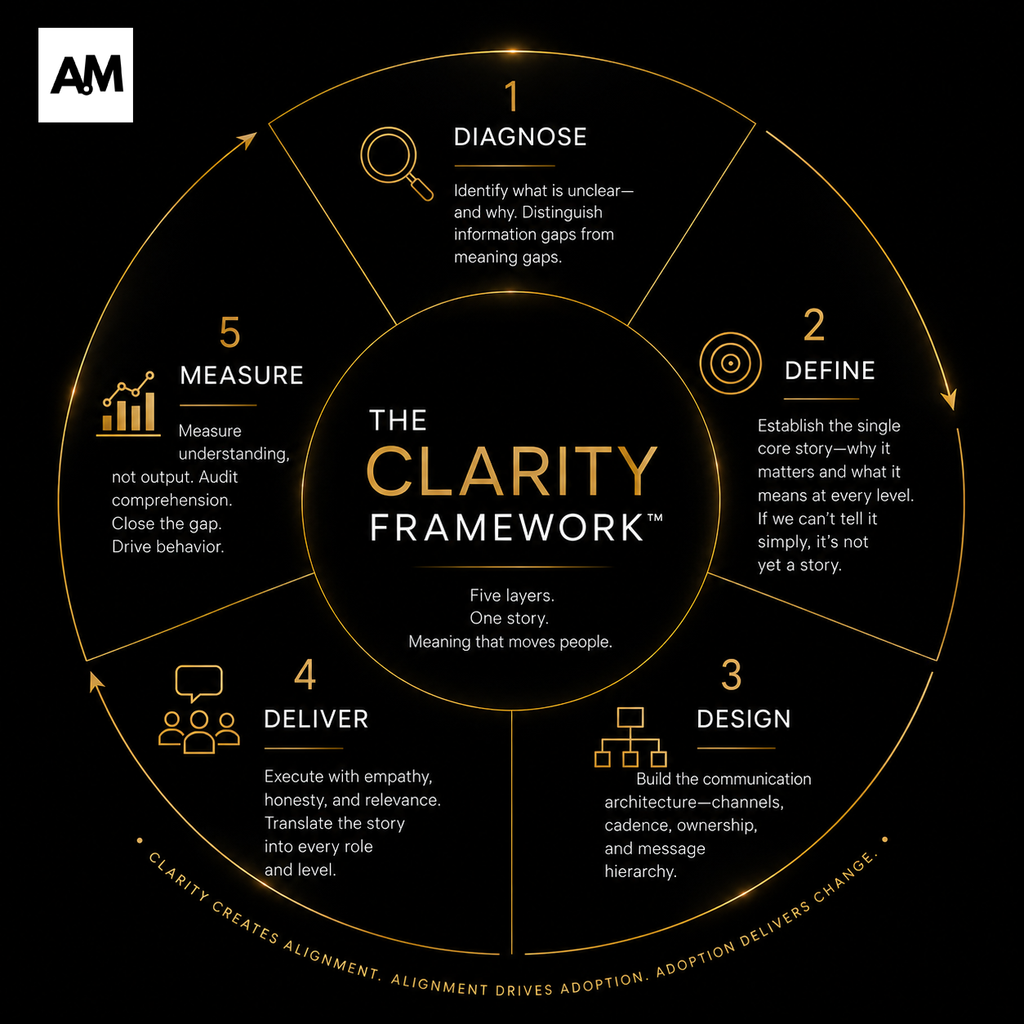
The Clarity Framework is a five-principle methodology built specifically for change communication — diagnose what’s blocking understanding, define the core story, design a human rhythm, deliver with empathy, and measure understanding not output. It’s the strategic backbone behind everything on this site.
Ana Magana is a strategic communications and change management consultant based in Calgary, Alberta. She helps organizations navigate transformation with structure, empathy, and storytelling — through The Clarity Framework™.
If your organization is navigating change and you’re not sure why communication isn’t landing, that’s often where the work begins. Work with Ana →
Read: The Psychology of Change Fatigue | 5 Signs Your Change Communications Strategy Isn’t Actually a Strategy (And How to Fix It) | The Clarity Gap: Why Leaders Think They’re Being Clear (But Aren’t)